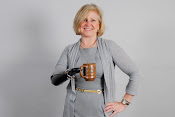
Empowering others: sharing experiences, ideas; offering creative solutions to common challenges.


Write to me at b.able2@yahoo.com
Showing posts with label occupational therapy. Show all posts

Thursday, April 12, 2012

Lemonade

So, let's get back to this idea of a positive attitude.... to create a word-picture for you, I'll use the idea of making lemonade from the lemons handed to each of us by.... well, the challenges of life. We all have them (referring to challenges!) whether we have 2 hands or not. What matters is what we do with the challenge. Have you ever thought about your strengths, abilities or talents? If you don't use them, they will not continue to be a strength to you. Challenges are not much different. If you don't face them, deal with them and learn to work around them, you will not be strengthened. By exercising* (i.e. learning a 'work-around' to) your weakness, you actually exorcise (eliminate) your weakness and in that way, the challenge actually becomes a strength. Simply stated, our weakness can actually become our strength.
Many times people who do not know me will make initial  statements such as this: "Oh, how terribly difficult to go through life without a hand" or "You poor thing..."
If I had not been born without my hand:
1. I would not likely be an occupational therapist (for the past 34 years) ;
2. I would not likely have conceived of the idea for the cutaneous anchor technology to change access to body power without harnessng in an upper extremity prosthesis;
3. I would not have started this blog that now circles the globe;
4. or the company Single-Handed Solutions that offers creative solutions in simple technology and adaptive strategies.
Although I don't honestly know if I would actually CHOOSE to not have a hand, what I do know is this:
1. There are far worse things one might endure than not having two hands;
2. Some of my most difficult life experiences had less to do with not having two hands and were more related to not making the best choice;
3. I am not a 'poor thing'...
I am blessed with a wonderful family and my life is rich with meaningful relationships. I have employment that is more than a job; it is a ministry and an opportunity to make a difference in the lives of others and in our world.
Lemons, anyone? They are an opportunity to make lemonade... or even occasionally limoncello!


Tuesday, April 3, 2012

“Man, through the use of his hands, as they are energized by mind and will, can influence the state of his own health."

Yesterday I posted this quote by Mary Reilly, an American OT; leader in the profession. How bold! How dare I post these words on a blog that claims devotion to those of us with upper limb deficiency! How seemingly insensitive to challenge those without hand(s) to perceive that their health -and perhaps well-being or even success, lies in the use  of the hands.
Do not misunderstand... I do challenge you with these same words: as an occupational therapist, as a peer, as a mentor. But hear ALL  of the words: they say. "... through the use of (his) hands, as they are energized by mind and will..."
How interesting that I have started this section on 'attitude'. This quote actually speaks to attitude: the mind and the will which are seated on the throne of attitude!
We must determine within our own 'self' to influence our own state. It's not a matter of actually having hands, but of finding ways, methods, strategies to accomplish tasks using the tools at our disposal. For some, the prosthesis may become the natural extension of the residual limb. For others, the residual limb can provide whatever is needed to meet the physical, and psycho-emotional demands. For some, the will to achieve is stronger and mightier than discouragement. For others discouragement and even temporal setback becomes a reason to quit. For some, an open mind yields possibilities toward success. For others, the mind is closed to thinking that more than one route leads to achievement. Where are you in the crowd? Are you among the believers, the doers and the possibility-thinkers?
I encourage you to begin today.... put your mind and your will at the helm of a positive attitude! If you need help; write to me... I will be happy to encourage you!
Let me conclude by sharing some words of wisdom from my parents...
" (Debi, ) you can accomplish anything that you want to do... You may have to do it differently, but you can do anything that you set your mind to do. You will just have to want to do it badly enough.
And we are here to help you."

Hmm; it seems that my parents knew that the energy of the mind and the will had the power to unseat doubt and despair and facilitate accomplishment. Kudos to you, Mom and Dad! Oh, and thank you.

Wednesday, October 19, 2011

Recently Published Article on the Shriners Blog!

Debra A. Latour, M Ed, OTR/L, has worked at Shriners Hospitals for Children in Springfield, Mass for 13 years. Before she was employed by the hospital, she was a patient. Her parents sought treatment at Shriners when she was a toddler for an upper limb deficiency.
For many years, Debi used the traditional body-powered prosthesis which is activated by a figure-of-eight or a figure-of-nine harness system, using the opposite shoulder as the power source. Many users of this system complain of discomfort from the harness, typically the rubbing on the skin by the harness, asymmetry of the shoulders, pain in the opposite shoulder area, difficulty while performing tasks with both limbs, and diminished physical appearance. When Debi began to experience her own problems with the usual harness system, she relied on her 30 years of experience to solve her issues.
As a Senior Occupational Therapist, Debi knows exactly how to help patients develop skills needed to live as independently as possible and to help improve the quality of their lives. In an effort to achieve these goals for patients with an upper limb deficiency, she invented a new and improved way of harnessing a body-powered prosthesis called the Ipsilateral Scapular Cutaneous Anchor system (the “Anchor”). Her design eliminates the usual harnessing, often a source of complaint and one reason why children reject prostheses.
Debi submitted a paper on the “Anchor” to the American Academy of Orthotists & Prosthetists which was accepted for presentation at the 2011 Annual Meeting & Scientific Symposium in Orlando, FL.  Presentations such as this serve to inform professionals in the community of new and creative solutions in treatment and also promote Shriners Hospitals for Children as a center of innovation and excellence in treatment, research and education.
While attending the symposium, Debi was interviewed by a reporter for O&P Business News.  She provides a wonderful account of how her invention and her blog, Single-Handed Solutions, materialized. Watch for the link soon.

Monday, August 16, 2010

How Do You Do.... Series Introduction

What an encouragement to receive your responses both publicly via blog and privately!! Thank you so very much.  To give you an idea of what to expect  in the very near future, and as part of the 'introduction', I was thinking about the phrase we have used so commonly when we meet another: "How do you do?". Frequently, after I meet someone I am asked, "How do you do.... (a specific task/activity)?"
So.... let's chat about that! I will be commenting on how I address specific bimanual tasks both with and without my prosthesis... When applicable, I may provide additional info between the voluntary closing (Adept) and voluntary opening (hook) terminal devices.
I've used the hook for most of my life. Believe it or not, it is by choice, and no, not because I loved being called names (you guessed it, Captain Hook was the most common, least imaginative!) It was because even early on, I recognized that for me, (and that is key) function takes precedence over cosmesis. At the time... and we are talking decades ago, there were not many choices! So as I introduce the How Do You Do series, let's talk about the 'times' and the culture of the times for a moment.  We now live in a culturally-diverse and culturally-aware society. Everything in medicine, education, government, economics, entertainment, commerce and religion speaks of it. But that was not always so...
I was born in the mid-1950's. If you were to Google those years you would find that Eisenhower was president, racial segregation was ruled unconstitutional, Rosa Parks refused to give up her seat on public transportation, the first US satellite completed orbit around the earth, Alaska and Hawaii became states and domestic airlines opened their passenger service between NYC and Miami. It was in this time that I was born; and in spite of not having all 10 fingers and all 10 toes; was "wondrously formed" (Psalms 139.14). Why is this important? It is important because:
a. it was the reality for that period of time; b. it would be a full 20 year time period when the period of 'tolerance' would then emerge; c. it paves the way for the period of  'acceptance' that we now experience.
My reality was this:
1. I was born without my right forearm and hand;
   (for the record, as scarey as this probably was for my parents, I do have multiple siblings who were born after me, all with 10 fingers and 10 toes!)
2. my parents taught me that God made me this way;
3. there was a measure of expectancy/accountability:
        -they also taught me that I could do everything  that anyone else could do,
        -especially if I wanted to, though I might need to do it differently;
        -they would help me to figure out those diffent ways
        -and that I was not 'lesser' for any of these reasons.
So the impact of these realities was this:
1. I could not change how I was born: "it is what it is";
2. there was a divine purpose and plan for me to be this way;
3. the opportunity of using a prosthesis (at that time, for that culture) was a privilege and the expectancy was that I would learn to tolerate and use it to the best of my ability with their encouragement and support to be the best I could be and on a par with my peers.
During early childhood through adolescence my options were a body powered hook, a body powered cosmetic hand, a passive cosmetic hand, or nothing. 'Nothing' was not really an option. -Not in my family culture! For me, in the 1960's and 1970's the body-powered hook was the best option: lightweight and functional. In my very pragmatic mind, I knew that I did not have 2 hands, was highly unlikely to grow a hand and decided that I did not need to look the part, but wanted to function the part!
Stay tuned for the next installment: How Do You Do......?