


debidoll1's photostream on Flickr.
Write to me at b.able2@yahoo.com
Saturday, March 31, 2012


Attitude!
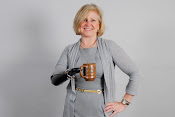
Let's talk about attitude! When I use that word, I'm referring specifically to how we carry ourselves... the image that we project, the message that our body language sends to others. As a little girl, I would often walk with my arms crossed in front of my body, my left hand holding my prosthesis at the elbow. To my parents, this gave the appearance that I was hiding my prosthesis or that I was ashamed of it. As I reflect about this now I know that it was less about hiding it.... I didn't have enough 'world experience' to be hiding it.... it was about balance and the integration of my lengthened prosthetic extremity with the rest of my body. If our trunk is the core, that is where we perceive stabilization; I remember that feeling of 'unbalance' and that by holding myself close to my core, I felt more stable, physically balanced.
So, what does that have to do with attitude? Well; I'm getting to that!!! I often refer to my parents as visionaries... When I was born, sans right forearm, they had a vision that I would be every bit as able and capable as the next person... or even more (yes, my parents expected personal excellence from each of us). There is a scripture that says... "without a vision, the city perishes"... so for success to occur, we must have a goal that we strive to achieve. There is no one way to achieve the goal, but many; and some of the ways are better than others. Throughout my childhood, my parents would work with me on my posture: not slumping forward, not leaning to one side, feet pointed forward, feet shoulder-width apart, head held high, looking forward not down; and eye contact. Did I mention the smile? All of these factors are beneficial for a growing musculoskeletal system, but are also vital to a developing body image... no matter what the age, no matter what the onset of limb loss. My parents were so focused on the vision that they had that they pursued and even created opportunities for me to achieve and to acquire the vision for myself.
How did they do this? BY EXAMPLING the attitude of meeting life and its 'situations' head-on with feet firmly planted, head held high and eyes focused. Yes, and with a smile! There was no problem, whether it was learning to cut with scissors (only right-hand scissors were available in schools in the 1960's; I do not have a right hand and my parents had to find left-hand scissors... or even if they existed! Ha ha; there was no internet then to 'google' resources!); devising a method to hold a pick in order to play guitar (thanks Dad!); enrolling in a 'finishing' class during awkward adolescence to pull it all together (thanks Mom for the "Sitting Beauty" program!) or recovering from rejection of others because I was 'different'... any disappointment was met with the same objective: overcoming the challenge. So, I've introduced to you the importance of a vision and the influence of a positive attitude.... stay tuned, next we'll talk about that smile.... oh, and lemons!!!!
So, what does that have to do with attitude? Well; I'm getting to that!!! I often refer to my parents as visionaries... When I was born, sans right forearm, they had a vision that I would be every bit as able and capable as the next person... or even more (yes, my parents expected personal excellence from each of us). There is a scripture that says... "without a vision, the city perishes"... so for success to occur, we must have a goal that we strive to achieve. There is no one way to achieve the goal, but many; and some of the ways are better than others. Throughout my childhood, my parents would work with me on my posture: not slumping forward, not leaning to one side, feet pointed forward, feet shoulder-width apart, head held high, looking forward not down; and eye contact. Did I mention the smile? All of these factors are beneficial for a growing musculoskeletal system, but are also vital to a developing body image... no matter what the age, no matter what the onset of limb loss. My parents were so focused on the vision that they had that they pursued and even created opportunities for me to achieve and to acquire the vision for myself.
How did they do this? BY EXAMPLING the attitude of meeting life and its 'situations' head-on with feet firmly planted, head held high and eyes focused. Yes, and with a smile! There was no problem, whether it was learning to cut with scissors (only right-hand scissors were available in schools in the 1960's; I do not have a right hand and my parents had to find left-hand scissors... or even if they existed! Ha ha; there was no internet then to 'google' resources!); devising a method to hold a pick in order to play guitar (thanks Dad!); enrolling in a 'finishing' class during awkward adolescence to pull it all together (thanks Mom for the "Sitting Beauty" program!) or recovering from rejection of others because I was 'different'... any disappointment was met with the same objective: overcoming the challenge. So, I've introduced to you the importance of a vision and the influence of a positive attitude.... stay tuned, next we'll talk about that smile.... oh, and lemons!!!!
Wednesday, October 19, 2011
Recently Published Article on the Shriners Blog!
 Debra A. Latour, M Ed, OTR/L, has worked at Shriners Hospitals for Children in Springfield, Mass for 13 years. Before she was employed by the hospital, she was a patient. Her parents sought treatment at Shriners when she was a toddler for an upper limb deficiency.
For many years, Debi used the traditional body-powered prosthesis which is activated by a figure-of-eight or a figure-of-nine harness system, using the opposite shoulder as the power source. Many users of this system complain of discomfort from the harness, typically the rubbing on the skin by the harness, asymmetry of the shoulders, pain in the opposite shoulder area, difficulty while performing tasks with both limbs, and diminished physical appearance. When Debi began to experience her own problems with the usual harness system, she relied on her 30 years of experience to solve her issues.
As a Senior Occupational Therapist, Debi knows exactly how to help patients develop skills needed to live as independently as possible and to help improve the quality of their lives. In an effort to achieve these goals for patients with an upper limb deficiency, she invented a new and improved way of harnessing a body-powered prosthesis called the Ipsilateral Scapular Cutaneous Anchor system (the “Anchor”). Her design eliminates the usual harnessing, often a source of complaint and one reason why children reject prostheses.
Debi submitted a paper on the “Anchor” to the American Academy of Orthotists & Prosthetists which was accepted for presentation at the 2011 Annual Meeting & Scientific Symposium in Orlando, FL. Presentations such as this serve to inform professionals in the community of new and creative solutions in treatment and also promote Shriners Hospitals for Children as a center of innovation and excellence in treatment, research and education.
While attending the symposium, Debi was interviewed by a reporter for O&P Business News. She provides a wonderful account of how her invention and her blog, Single-Handed Solutions, materialized. Watch for the link soon.
Friday, February 4, 2011
How Have You Been...?
Hello Everyone! I hope that you have enjoyed festive holidays and are entertaining a blessed new year.... Now, as much as we here in the northeast might love our four seasons (yes, winter being one of them), I for one am seriously looking forward to a pleasant spring!
I apologize for the long hiatus and though I was not publishing entries, I do have 10 "in the works" and almost ready for your review. Before I tell you what we will be discussing, I would like to take a moment to share some of my adventures. I had the privilege of travelling to Belgium to speak at the Loth Symposium at the invitation of Dr.Corrie von Sluis and Mr. Gerritt Visser from The Netherlands. I re-acquainted with several occupational therapists, prosthetists and engineers and learned much from them. It was a fantastic opportunity and I enjoyed a wonderful time. Thank you to you all!
Upon my return I underwent surgery with a lengthy recuperation. During this time I responded personally to many of your inquiries and drafted the entries that you will be reading. We will pick up where we left off: with activities of daily living. These upcoming issues will demonstrate strategies for completing various fasteners on clothing and jewelry, as well as diversional activities... cutting, computer key boarding, playing the guitar and knitting.
Thank you for reading and being a part of this blog. Single-Handed Solutions is now read in 51 countries and is translated into 34 languages. As in the past I look forward to your comments, suggestions and inquiries. May you be richly blessed!
I apologize for the long hiatus and though I was not publishing entries, I do have 10 "in the works" and almost ready for your review. Before I tell you what we will be discussing, I would like to take a moment to share some of my adventures. I had the privilege of travelling to Belgium to speak at the Loth Symposium at the invitation of Dr.Corrie von Sluis and Mr. Gerritt Visser from The Netherlands. I re-acquainted with several occupational therapists, prosthetists and engineers and learned much from them. It was a fantastic opportunity and I enjoyed a wonderful time. Thank you to you all!
Upon my return I underwent surgery with a lengthy recuperation. During this time I responded personally to many of your inquiries and drafted the entries that you will be reading. We will pick up where we left off: with activities of daily living. These upcoming issues will demonstrate strategies for completing various fasteners on clothing and jewelry, as well as diversional activities... cutting, computer key boarding, playing the guitar and knitting.
Thank you for reading and being a part of this blog. Single-Handed Solutions is now read in 51 countries and is translated into 34 languages. As in the past I look forward to your comments, suggestions and inquiries. May you be richly blessed!
Thursday, October 21, 2010
How Do You Do...Fastening a Watch?

Without a prosthesis:
First the traditional buckle style watchband:
Positioning is important for my success. I wear my watch on my left wrist and will typically support my left forearm on my left thigh to stabilize the area so that I can best maneuver my residual limb. I 'grasp' the watch with the crook of my right elbow and position the watch on my wrist.


And now the double hinge metallic strap:
Again, positioning is a key to sucess. I drape the watch over my wrist using my residual limb. My left forearm is supported on my thigh to stabilize my arm during the task.


With a prosthesis:
The traditional buckle watchstrap:
I drape the watch on my wrist, pinch the strap, push and then pinch and pull it to get it through the buckle.


And finally the double hinge watchstrap:
I grasp the watch with the terminal device and position it on my wrist.


I line up the hooks on the clasp and then pinch


Then I fold over the second hinge and repeat the process


And the watch is on.
I must confess that photographs give the appearance of simplicity. I have spent many hours practicing these techniques, beginning when I was very young. Don't be discouraged... any skill worth acquiring is worth working toward with diligence! And being maximally functionally independent is a worthy goal.
Next to be published will be buttoning the cuff button ... Check back next week!!
In the meantime, be well, be blessed.
Tuesday, October 12, 2010
How Do You Do.... Gloves?
Let's talk about something new.... We cleaned closets this week-end in anticipation of the cold weather approaching quickly! Temperatures here in New England are expected to plummet with the high only reaching about 50 degrees. I'll need to don a hat and gloves for our nightly walk. I don't know about you, but it can be costly buying gloves. Good gloves typically are priced beginning at $20; more for fitted or lined leather; less for the cheapies. In any case, I don't like paying $20 for the use of only one glove!! Especially since I'm likely to lose the left (the one I need and use) and am stuck with the right! (Anyone need a right hand glove? I do have a few!) There have been times when friends or family will pass on to me the left hand glove when they have misplaced the right in the pair. -One glove is not usually helpful for a two-handed person, but can be a blessing to me!

Over the years I've discovered a few helpful hints to keep my hand warm during chilly weather.... my favorite of course is to hold hands with my husband. But there are times when one needs a glove or a mitten. The least expensive option is the 'magic glove'. These are sold in a universal pair, meaning that it's a set of two and that both gloves fit either hand. They are available in a wide assortment of colors and sizes for both adults and children. The benfits are that they are cheap and useable for either hand. The drawback.... they are cheap and not overly warm. One might have to wear a few layers of magic gloves to have a warm hand.

Another solution is the knitted woolen glove or a fleece glove. These are sold in fitted pairs and are warmer than the magic gloves. Since they are fitted and are hand-specific, the problem is that a one-handed person cannot use the other glove.... unless you turn it inside out.


Granted, it's not pretty, but when it comes right down to it function wins over form for staying warm. I'd rather look like a goof and be toasty warm than freezing and frost-bitten.
When I'm out on my snow shoes I like to wear my heavy fleece mittens, often with a pair of insulated glove liners. (True, I don't really wear the pair; I only use the liner on my hand; my prosthesis does not need the extra insulation!) In any case, the mitten fits nicely over my Adept terminal device, don''t you think???

Lastly, and probably most special of all is the pair of fingerless gloves that my friend Hermine knitted especially for me. They keep the palm warm and look chic. Of course, I have the pair to add symmetry!


Over the years I've discovered a few helpful hints to keep my hand warm during chilly weather.... my favorite of course is to hold hands with my husband. But there are times when one needs a glove or a mitten. The least expensive option is the 'magic glove'. These are sold in a universal pair, meaning that it's a set of two and that both gloves fit either hand. They are available in a wide assortment of colors and sizes for both adults and children. The benfits are that they are cheap and useable for either hand. The drawback.... they are cheap and not overly warm. One might have to wear a few layers of magic gloves to have a warm hand.

Another solution is the knitted woolen glove or a fleece glove. These are sold in fitted pairs and are warmer than the magic gloves. Since they are fitted and are hand-specific, the problem is that a one-handed person cannot use the other glove.... unless you turn it inside out.


Granted, it's not pretty, but when it comes right down to it function wins over form for staying warm. I'd rather look like a goof and be toasty warm than freezing and frost-bitten.
When I'm out on my snow shoes I like to wear my heavy fleece mittens, often with a pair of insulated glove liners. (True, I don't really wear the pair; I only use the liner on my hand; my prosthesis does not need the extra insulation!) In any case, the mitten fits nicely over my Adept terminal device, don''t you think???

Lastly, and probably most special of all is the pair of fingerless gloves that my friend Hermine knitted especially for me. They keep the palm warm and look chic. Of course, I have the pair to add symmetry!

Sunday, October 10, 2010
How Do You Do... Play Guitar?
My parents let me have guitar lessons beginning in the fourth grade. -I wanted to learn to play so badly! It was about 1965; the Beatles had already won popularity in the U.S. and with it, the guitar became popular as well. As much as I wanted to play, I have to admit that I did NOT love to practice! But that isn't the point of this entry; HOW I PLAYED is the message.
Remember, I have my left hand and use a prosthesis on the right. My left hand manipulated the frets and supported the neck of the instrument. My hook held the pick and strummed the strings. I encountered a few problems however. My cable to activate the hook dug into my upper arm when I positioned my arm around the guitar. Initially I was wearing a prosthesis with a figure of 8 harness. My prosthetist through Shriners Hospitals for Children modified it to a figure of 9 with a Muenster socket and this arrangement solved that problem. My second problem was that the pick would slide out of the tines of my hook. My parents, being very savvy and out-of-the-box-thinkers, glued dense foam on the pick so that I could grab the material instead of sliding off the smooth surface. And my dad came across a rubber tubing which we cut in half-inch lengths and placed on the hook tines so that my hook would remain closed on the pick. (The excursion of my prosthesis around the folk guitar would cause the hook to open) Now, if I'd had a Lite Touch or my current Adept voluntary closing terminal device, I could have worked to maintain the pinch or kept the pick in place with the Sure-lock system. But those had not yet been invented! My third problem? I am not very musical!!

Remember, I have my left hand and use a prosthesis on the right. My left hand manipulated the frets and supported the neck of the instrument. My hook held the pick and strummed the strings. I encountered a few problems however. My cable to activate the hook dug into my upper arm when I positioned my arm around the guitar. Initially I was wearing a prosthesis with a figure of 8 harness. My prosthetist through Shriners Hospitals for Children modified it to a figure of 9 with a Muenster socket and this arrangement solved that problem. My second problem was that the pick would slide out of the tines of my hook. My parents, being very savvy and out-of-the-box-thinkers, glued dense foam on the pick so that I could grab the material instead of sliding off the smooth surface. And my dad came across a rubber tubing which we cut in half-inch lengths and placed on the hook tines so that my hook would remain closed on the pick. (The excursion of my prosthesis around the folk guitar would cause the hook to open) Now, if I'd had a Lite Touch or my current Adept voluntary closing terminal device, I could have worked to maintain the pinch or kept the pick in place with the Sure-lock system. But those had not yet been invented! My third problem? I am not very musical!!

Subscribe to:
Posts (Atom)